

If you’ve ever stood in the middle of a room you’re trying to decorate — a new home, a space you’ve lived in for years, somewhere in between — and felt completely frozen about where to start, this post is for you. Not because I have all the answers, but because I’ve been exactly there. Overwhelmed, Pinterest-saturated, and somehow still figured out how to start decorating a home that felt like mine.
Part 01 of this series was about something I wish someone had told me sooner: before you know how to decorate a room from scratch, you have to know what you’re decorating toward. Not a style label. A feeling.
If you haven’t read it yet, it’s a good place to start — but you don’t need it to follow along here.
Everyone has a sense of how they want their home to feel.
The overwhelm comes from not knowing where to start. This is how you turn that feeling into a plan.
Why home decorating feels so overwhelming
The problem with starting usually isn’t taste. It often isn’t budget either, though that’s always a real constraint.
The problem is sequence.
Most of us start decorating a new home or room by buying things that feel right in isolation. A sofa here. A throw pillow there. A rug that looks incredible in the store and confusing in the living room. We end up with a collection of pieces that each made sense on their own, but don’t add up to anything that feels intentional.
That’s a starting-point problem. And the fix isn’t more inspiration — it’s a different order of operations.
The system I’m sharing here is what shifted things for me. It won’t make decorating effortless, and it won’t guarantee you won’t make mistakes — I still make them. But it gives you a structure to move through, which is the one thing most decorating advice skips.
Step 01 — Give the feeling words
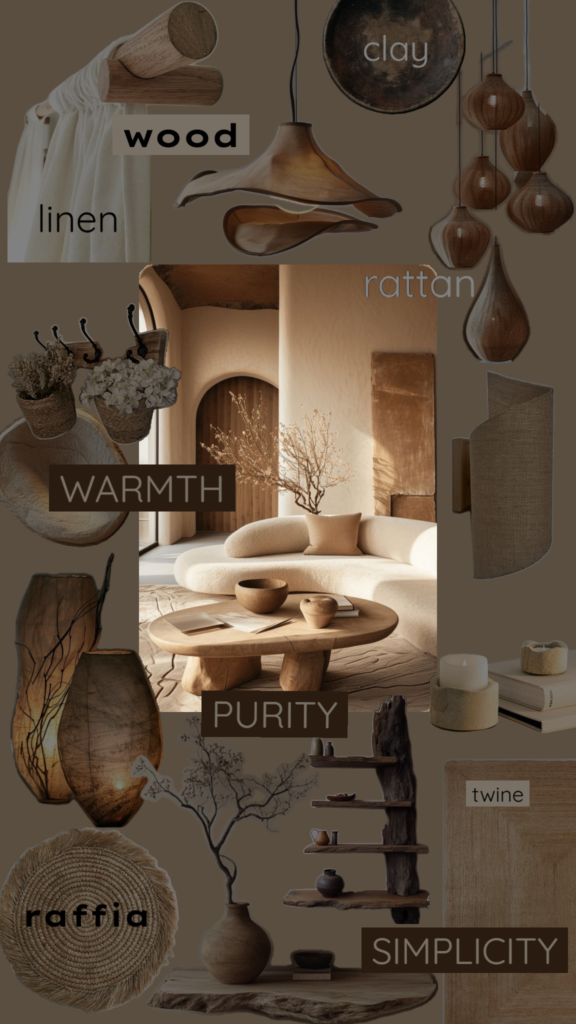
collage designed by Алена К
Before you can start making decisions about your space, you need to be able to describe what you want from it. Not in terms of style labels — not ‘Japandi’ or ‘coastal grandmother’ or whatever Pinterest is calling it this year — but in terms of feeling.
Go back to whatever you saved in Part 01 — your Pinterest board, your screenshots, the images that stopped you mid-scroll. Look at them as a group. What do they have in common? Not the aesthetic, the feeling.
Is it warmth? Quietness? A sense of things being well-chosen rather than abundant? Is it organic and alive, or pared-back and still? Does it feel like someone lives there fully, or like it’s a place you arrive into and decompress?
Write down three to five words that keep appearing across your saves. These become your interior language — and your filter.
Mine are: light, airy, intentional, warm, and, layered. Every decision I make about my home runs through those five words. If something doesn’t serve at least one of them, it doesn’t belong — no matter how beautiful it is on its own.
Your feeling words are not just a mood board exercise. They are a decision-making filter you’ll use for every single purchase and placement from here on
Step 02 — Read what your saves are actually telling you
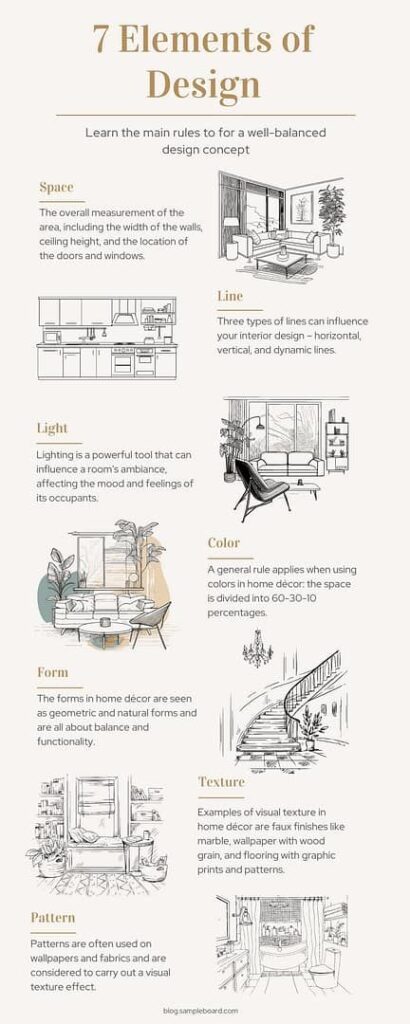
7 Elements of Design by sampleboard
Once you have your words, go back to your saved images one more time — but this time you’re looking for patterns in what you keep gravitating toward.
What materials keep appearing?
Linen, clay, raw wood, marble, woven textures, plaster, glass.
Materials carry feeling in a way color doesn’t. A room full of natural textures will feel grounded regardless of the color palette. Start noticing what your saves are built from, not just what they look like.
What’s the color temperature?
Warm (creams, terracottas, honeys, warm whites) or cool (greys, blues, stark whites, greens)? Most people have a strong pull in one direction even if they haven’t named it. Neutral doesn’t mean without temperature — it just means subtle. Know which direction yours leans.
What’s the relationship between objects?
Are things close together and layered, or spread out with breathing room? Is it abundant or restrained? Is there a lot of visual texture or very little? This tells you how dense your own space should feel — and whether the overwhelm you’re feeling is because your room is under-furnished or over-cluttered.
What’s the scale?
Do you keep saving rooms with large, bold anchor pieces and minimal accessories? Or lots of smaller collected objects that add up to something rich? Scale preference is one of the most overlooked parts of figuring out where to start decorating. Getting it wrong is often why a room feels off even when everything in it is individually beautiful.
Write these observations down alongside your feeling words. Together, they are your brief — the document you’ll refer back to every time you’re about to make a purchase
Step 03 — Source in order
I am going to say this louder so everyone can hear.
The reason home decorating feels overwhelming is often because we’re trying to solve all of it at once.
The fix is a sequence. Start with the anchor piece
Every room has one. In a living room, it’s usually the sofa. In a bedroom, the bed frame and mattress. In a dining room, the table. The anchor piece is the largest thing in the room and the thing every other decision responds to.
This is where your budget should be concentrated, and this is the piece you should spend the most time choosing. Because getting it right makes everything else easier. Getting it wrong means every subsequent purchase is fighting an uphill battle.
Run it through your feeling words before you commit. Ask: does this piece feel warm, grounded, deliberate — or whatever your words are? If it doesn’t, it’s not the right anchor regardless of how practical or budget-friendly it is.
In the bedroom: bedding before headboard
This one is worth its own paragraph because almost everyone gets it backwards. Most people shop for a bed frame and headboard first because it feels like the structural decision, then treat bedding as an afterthought.
But you interact with your sheets every single night before you notice anything else in that room. The quality, weight, and feel of your bedding shapes how you experience your bedroom more than any other element — more than the headboard, more than the art, more than the lighting. Invest here first.
Choose bedding that genuinely feels the way you want your bedroom experience to feel.
Then the rug
A rug defines the zone. It’s the second largest decision in most rooms and the one that ties the anchor piece to the rest of the space. Size matters more than pattern — most people choose rugs that are too small. If you’re unsure, go bigger than you think you need.
Then lighting
Lighting is the most underinvested area in most homes and the single change that transforms a room more than almost anything else — yet it’s consistently treated as an afterthought.
Layer it. Ambient light (general room illumination), warm light (table lamps, floor lamps), and atmospheric light (candles, low-wattage task lighting). Overhead ceiling lights alone are almost never enough to make a room feel the way you want it to feel.
If your room feels cold or flat, before you buy anything new, change the lighting first. Swap overhead bulbs for warmer ones, add a lamp, light a candle. It costs almost nothing and the difference will surprise you.
Objects, art, and the personality layer come last
This is the part everyone wants to start with — the ceramics, the candles, the art, the collected objects that make a room feel like yours. And it’s the part that should come last.
Not because it’s less important. It’s actually where the feeling of a room lives. But these pieces can only do their work when the foundation is right. Objects placed in a room with the wrong anchor, the wrong lighting, the wrong scale — they disappear. The same objects in a room where everything underneath them is correct become extraordinary.
Do the bones first. Then let the details speak.
The personality layer is where the feeling lives. But it needs the bones to hold it up.
I want to be direct about something: you can follow this system exactly, make every decision deliberately, run everything through your feeling words — and still end up with a piece that doesn’t work. A sofa that photographs beautifully but feels wrong in the room. Art that made your heart catch and somehow flattens the wall it’s on.
That’s not the system failing. That’s the reality of building something. Taste develops through doing, through trying, through living with decisions and noticing what holds and what doesn’t. The system doesn’t make you immune to wrong calls. It just means you make fewer of them, and you make them with more intention.
I want to be direct about something: you can follow this system exactly, make every decision deliberately, run everything through your feeling words — and still end up with a piece that doesn’t work. A sofa that photographs beautifully but feels wrong in the room. A rug that seemed perfect and reads as muddy. Art that made your heart catch and somehow flattens the wall it’s on.
That’s not the system failing. That’s the reality of building something. Taste develops through doing, through trying, through living with decisions and noticing what holds and what doesn’t. The system doesn’t make you immune to wrong calls. It just means you make fewer of them, and you make them with more intention.
For now — start with the feeling. Give it words. Source in order. And give yourself the grace to get some of it wrong.
Home takes time. Taste develops through living — through trying, through noticing what’s working and what’s not.
You are not behind.
0 Comments